

Ivanna Klympush-Tsintsadze at Aspen Institute France’s Geopolitical Luncheon: Ukraine’s Recovery and the Question of Justice
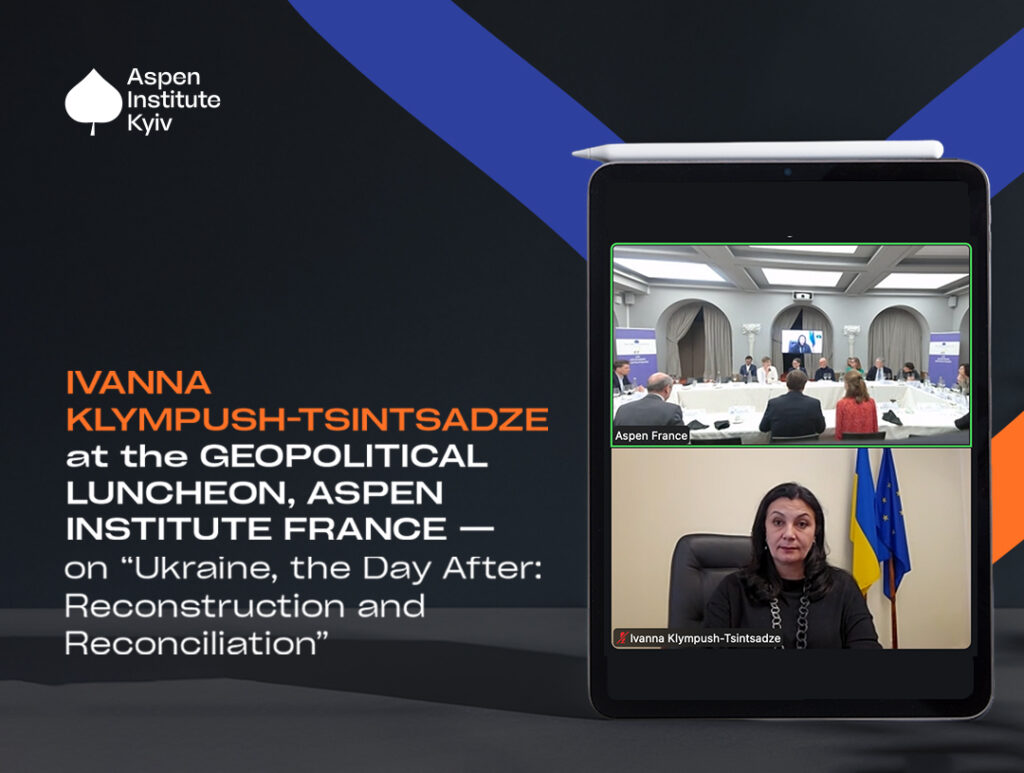
On 17 February, Aspen Institute France hosted its Geopolitical Luncheon in Paris—a closed-door dialogue bringing together leaders from business, politics, civil society, and the media to discuss pressing international issues. This edition focused on “Ukraine: The Day After – Reconstruction and Sustainable Recovery,” exploring both the challenges of rebuilding Ukraine and the difficult questions surrounding post-war reconciliation.
Among the participants was Pierre Heilbronn, Special Envoy of the President of France for Ukraine’s Relief and Reconstruction.
Representing Ukraine, Ivanna Klympush-Tsintsadze, Chair of the Committee on Ukraine’s Integration into the European Union of the Verkhovna Rada of Ukraine, took part in the discussion.
“A well-defended, democratic Ukraine as part of the European community is in Europe’s own interest,” she stressed.
Ivanna Klympush-Tsintsadze noted that it is extraordinarily difficult to speak about “the day after the war” while the war itself continues—with relentless attacks, loss of life, and profound human suffering. Ukraine, she said, will not return to its pre-war reality. At the same time, she observed that despite significant international support, the West has yet to develop a unified and consistent approach to responding to Russia’s aggression.
“At the moment, the United States is acting as though it were mediating between two equal parties pursuing their own interests. But these are not equal sides. There is a clear aggressor—Russia—and there is a victim—Ukraine. Unfortunately, the American side is losing sight of this distinction when it calls for concessions from both.”
According to Ivanna Klympush-Tsintsadze, even the most conservative estimates place the cost of Ukraine’s reconstruction at more than €700 billion. Yet reconstruction cannot simply mean rebuilding what has been destroyed. It must become an opportunity to create a new economic and industrial model aligned with European standards and democratic governance. Recovery, she argued, should proceed in parallel with Ukraine’s European integration, which remains the key driver of deep and lasting transformation.
She also cautioned against premature calls for reconciliation.
“Imagine if the Second World War had ended without the complete defeat of Nazi Germany—could anyone have spoken of reconciliation under those circumstances? The same applies today. Without accountability and justice for Russia’s crimes, there can be no meaningful discussion of reconciliation. That is not possible—not for us, and not for the next generation.”
For Ukraine, the pursuit of justice and accountability for war crimes is fundamental—not only for the present generation, but for those that follow.
Held under the Chatham House Rule, the discussion created space for an open exchange on the future of European security, Ukraine’s recovery, and the continent’s long-term future.
We are grateful to our colleagues at Aspen Institute France for creating this important opportunity for dialogue.
Ukraine is not only a matter of solidarity.
It is a matter of Europe’s shared security and the future of the continent.