


Ivanna Klympush-Tsintsadze Speaks at Aspen Institute Italia’s International Conference in Venice
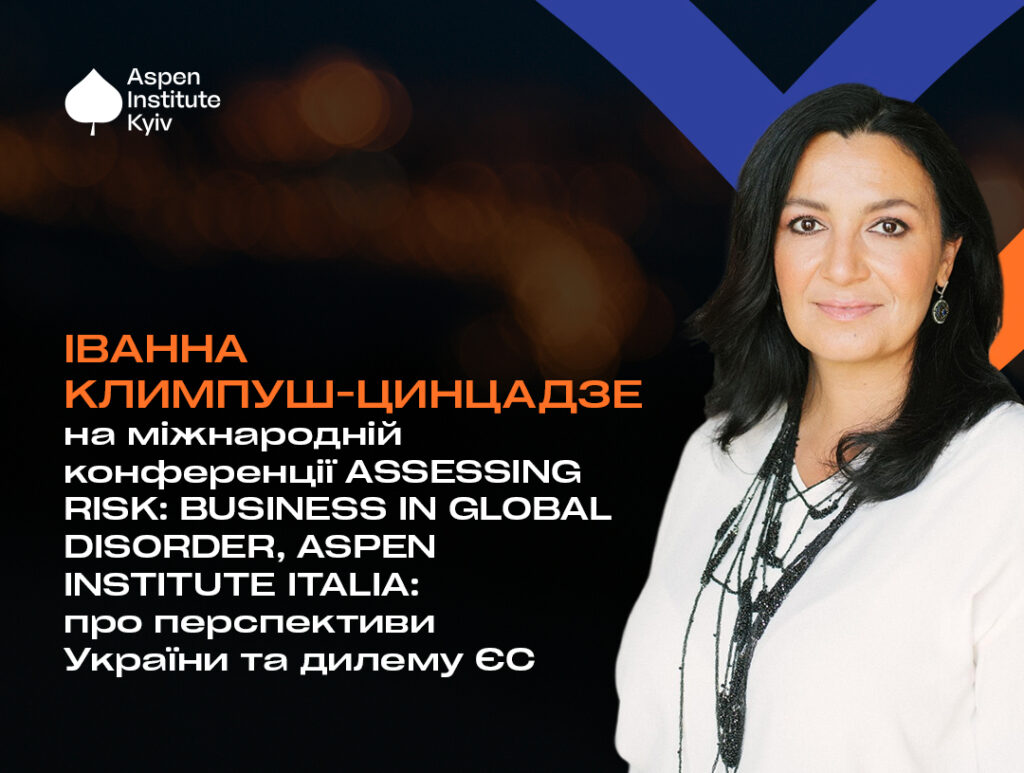
On 20–21 March, Aspen Institute Italia hosted the 12th International Conference, Assessing Risk: Business in Global Disorder, in Venice.
Ivanna Klympush-Tsintsadze, Chair of the Committee on Ukraine’s Integration into the European Union of the Verkhovna Rada of Ukraine, participated in the discussion “Ukraine’s Prospects and the EU’s Predicament,” alongside General Carmine Masiello, Chief of Staff of the Italian Army, and Ambassador Kurt Volker, Distinguished Fellow at the Center for European Policy Analysis (CEPA).
In her remarks, she focused on the changing nature of geopolitical risk and what this shift means for states and societies.
“Persistent geopolitical risk is now the new normal—the backdrop against which events unfold,” Ivanna Klympush-Tsintsadze said. According to her, geopolitical uncertainty is no longer a discrete risk that can be managed reactively; it has become the environment in which governments and societies must act by building long-term strategic resilience.
She stressed that Ukraine was among the first countries to confront this new reality. Despite the destruction of a significant share of its energy infrastructure, large-scale demographic displacement, and continued attacks on civilian targets, the country continues to demonstrate resilience.
Ivanna Klympush-Tsintsadze also highlighted Ukraine’s European path. “Today, there is no ‘third way’ for Ukraine between Europe and Russia,” she noted. In her view, accession to the European Union is not simply a matter of economic opportunity or political status, but fundamentally a process of deep internal transformation required to meet European standards.
She also emphasised that, despite a complex international environment and political constraints, Ukraine’s European integration process continues and remains one of the country’s central strategic priorities.
At a time when uncertainty has become the new normal, conversations like these are increasingly valuable as spaces for shared reflection, responsible leadership, and the search for common solutions.